Data Flow
BEC is built around shared event streams and coordinated service interactions. Requests, state updates, readouts, metadata, and file-writing signals move through the system in a way that lets multiple clients and services observe the same acquisition without duplicating the orchestration logic.
How Data Flows Through the System
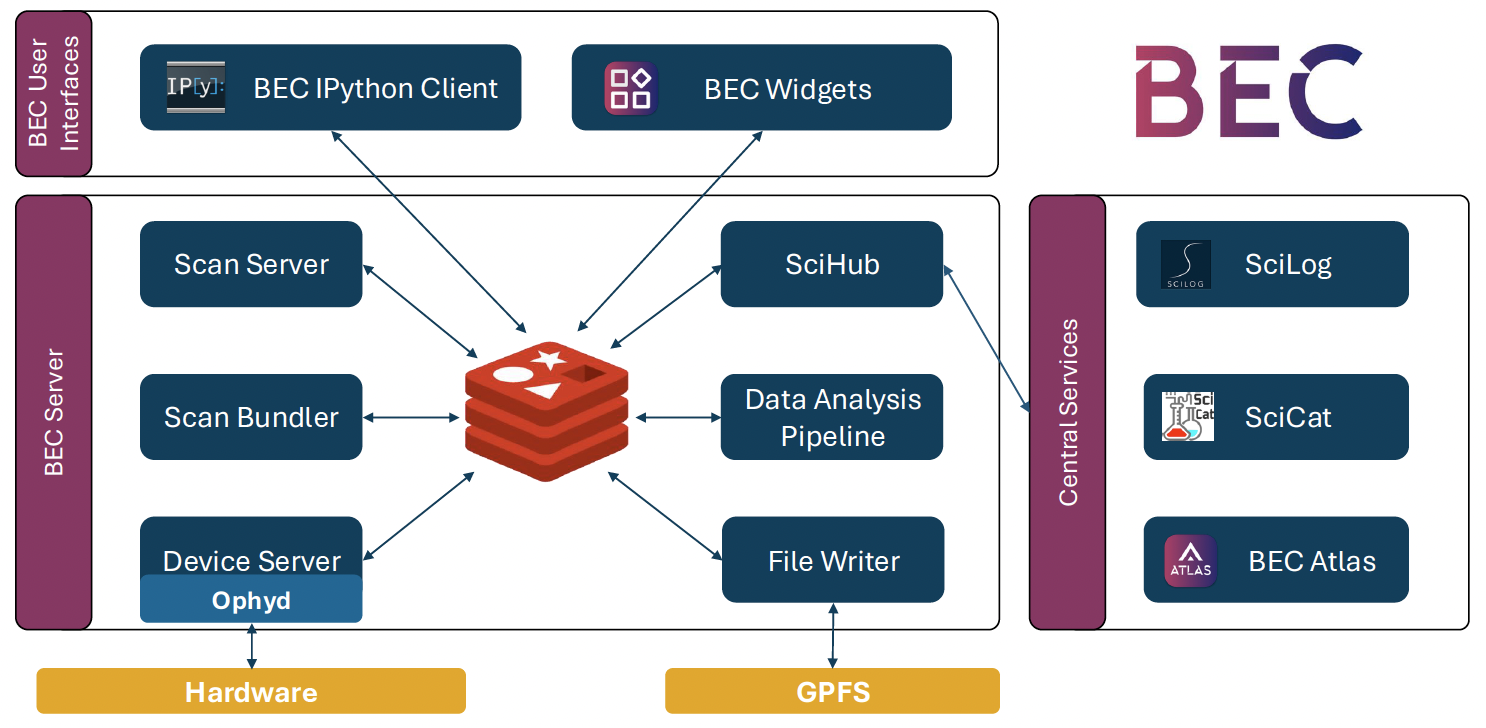
The exact message details depend on the scan type, but the overall lifecycle is:
- Client: A client (GUI or terminal) submits a scan request.
- Scan Server: The scan server validates the request and assembles scan instructions.
- Scan Server:The scan is inserted into a queue and picked up by a scan worker.
- Scan Worker: The scan worker issues device operations through Redis.
- Device Server:The device server performs the corresponding actions on ophyd devices.
- Device Server:Devices and services publish status, progress, metadata, and readouts back to Redis.
- Scan Bundler:The scan bundler synchronizes asynchronous readouts into logical scan points.
- Client, File Writer, SciHub, Data Analysis Pipelines: Clients, file writers, and analysis services consume those streams.
- File Writer: The file writer persists the scan to disk, while clients can still inspect recent results live or through history helpers.
What to remember
- Data in BEC flows through shared event streams rather than direct client-to-client control paths.
- A scan request moves from the client to the scan server, then through device execution and synchronized readout handling.
- The same live streams can be consumed in parallel by clients, the file writer, SciHub, and analysis services.
- Clients can stay lightweight because orchestration and synchronization remain on the backend.