Built-in scan catalog
This reference covers the built-in acquisition scans in BEC. Beamline plugins can add
scans or change their inputs and defaults. In IPython, scans. followed by Tab
lists the installed scans, and scans.<name>? shows the interface published by your server.
Examples use simulated dev.samx and dev.samy devices. Positions and distances use the
corresponding motor's units; acquisition times use seconds. Each call returns a ScanReport.
For a guided first measurement, see Run your first scan.
Scan lookup
| Scan | Pattern | Motors | Point count |
|---|---|---|---|
acquire |
Acquisition at current positions | None moved | 1 logical point |
time_scan |
Repeated acquisition over time | None moved | points |
line_scan |
Equally spaced, coupled axis positions | One or more | steps |
grid_scan |
All combinations of axis positions | Two or more | Product of axis counts |
list_scan |
Explicit, coupled position lists | One or more | Length of each list |
log_scan |
Coupled positions with increasing spacing | One or more | steps |
round_scan |
Concentric rings | Two | pos_in_first_ring * n * (n + 1) / 2, where n = number_of_rings |
round_roi_scan |
Circular shells clipped to a rectangle | Two | Number of retained positions |
fermat_scan |
Fermat spiral clipped to a rectangle | Two | Number of generated positions |
hexagonal_scan |
Staggered rows clipped to a rectangle | Two | Number of retained positions |
multi_region_line_scan |
Consecutive line regions | One | Combined region counts, minus shared boundaries |
multi_region_grid_scan |
Consecutive rectangular grids | Two | Sum of each grid's axis-count product |
cont_line_scan |
Moving acquisition near predefined targets | One | steps expected readouts |
line_sweep_scan |
Moving acquisition on readback updates | One | Variable; no predefined count |
Shared settings
Coordinates and return position
Use distinct motors in repeated argument bundles. All motion scans below require relative explicitly. With relative=False, supplied
positions are absolute. With relative=True, the scan adds the motor positions recorded
during preparation to the supplied offsets, including region bounds and ring centers.
Relative acquisition scans return to those starting positions on normal completion;
absolute scans leave the motors at the final trajectory position.
Limits are checked against the resulting positions. Relative scans normally also attempt
the return move in their exception hook; interruption without that hook, or a device
failure, can prevent the return. Neither acquire nor time_scan moves motors.
Acquisition options
These defaults apply to the unmodified built-ins. The ten step scans are the scans under Step trajectories.
| Option | Default | Meaning | Supported scans |
|---|---|---|---|
exp_time |
0 |
Exposure time requested from devices | All acquisition scans |
frames_per_trigger |
1 |
Frames per trigger for devices supporting that setting | Step scans, acquire, cont_line_scan, line_sweep_scan |
settling_time |
0 |
Delay before the software trigger | Step scans, acquire, time_scan |
settling_time_after_trigger |
0 |
Delay after triggering and before reading | Step scans and acquire |
readout_time |
0 |
Readout-time configuration for devices supporting it | Step scans, acquire, cont_line_scan |
burst_at_each_point |
1 |
Trigger/read cycles at each logical point | Step scans and acquire |
Step scans with N positions expect N * burst_at_each_point monitored readouts.
acquire expects burst_at_each_point readouts at its one logical point. Detector frames
are separate from this readout count; increasing frames_per_trigger does not add motor
positions. Exposure and settling times must be nonnegative, and frame/burst counts at least one.
Client options
The client accepts these options in addition to the scan's own parameters:
| Option | Default | Meaning |
|---|---|---|
monitored |
None |
Per-scan selection of devices to assign to monitored readout |
on_request |
None |
Per-scan selection of devices to assign to on-request readout |
metadata |
None |
Metadata merged with the client's metadata for this request |
file_suffix, file_directory |
None |
Overrides of the client's file settings for this scan |
scan_queue |
None |
Target queue; otherwise the client's default queue |
hide_report |
False |
Suppress the interactive progress display |
callback, async_callback |
None |
Callbacks for scan segments |
Enabled devices participate according to their
readout priorities. Motion scans also assign
scan motors to monitored readout. hide_report controls the display, not whether the
server executes the request. The
client implementation
defines the common options; each entry below describes the scan-specific inputs.
Static and time acquisition
acquire
Acquire at the current device positions without moving a motor.
- Inputs: no motor or trajectory arguments.
- Options: all shared acquisition options.
- Counts: one logical point;
burst_at_each_pointmonitored readouts.
scans.acquire(exp_time=0.1, burst_at_each_point=3)
This records three acquisitions at the same position. For repeated acquisition with a
specified interval, use time_scan.
time_scan
Acquire a specified number of times without moving motors.
- Inputs:
points: int,interval: float(nonnegative seconds). - Options:
exp_time=0,settling_time=0. - Counts:
pointslogical points and monitored readouts. - Timing: after each acquisition except the last, sleep for
max(interval - exp_time, 0). Trigger/read time and settling contribute to the actual interval; this is not a guarantee of exact wall-clock spacing.
scans.time_scan(5, 0.5, exp_time=0.1)
Unlike acquire bursts, time_scan takes an explicit interval. It has no
burst_at_each_point parameter.
Step trajectories
At each trajectory position, motors finish moving before the software trigger/read cycle.
All entries in this section support the shared acquisition options and require relative.
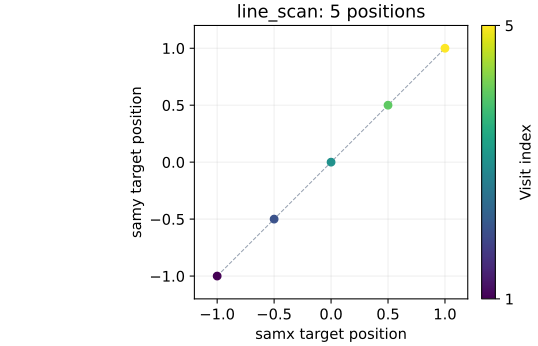
The plots show the positions from each example with the default one readout per position.
Colors progress from the first to the last visit; dashed lines join successive targets and
represent travel between them, not acquisition during motion.
line_scan
Move one or more motors through equally spaced positions together.
- Inputs: one or more repeated
(device, start, stop)bundles; requiredsteps: intgreater than zero. - Counts:
stepspositions, including start and stop whensteps > 1. - Multiple motors: each motor advances through its own range at the same point index; the scan follows a line through the combined coordinates, not a grid.
scans.line_scan(
    dev.samx, -1, 1, dev.samy, -1, 1,
    steps=5, relative=False, exp_time=0.1,
)
For all axis combinations, use grid_scan; for explicit positions,
use list_scan.
grid_scan
Visit every combination of the supplied axis positions.
- Inputs: two or more repeated
(device, start, stop, steps)bundles. Each axis count is a positive integer. - Options:
snaked=Truereverses traversal on alternate passes;Falserepeats the same direction. The first supplied motor is the fastest-changing axis. - Counts: product of the axis counts. Start and stop are included on axes with more than one position.
scans.grid_scan(
    dev.samx, -1, 1, 5, dev.samy, -1, 1, 3,
    relative=False, exp_time=0.1,
)
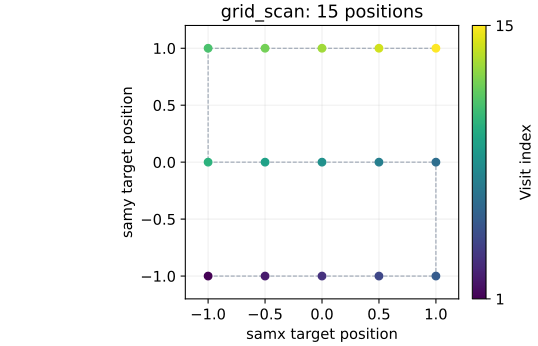
This example has 15 positions, rather than the five coupled positions of a two-motor line scan.
list_scan
Visit explicit positions in the order provided.
- Inputs: one or more repeated
(device, positions)bundles, wherepositionsis a list of floats. All lists must have equal, nonzero length. - Counts: the length of one list, not the product of the list lengths.
- Multiple motors: entries at the same list index form one combined position.
scans.list_scan(
    dev.samx, [-1.0, 0.5, 0.0, 1.0],
    dev.samy, [-0.5, -0.5, 1.0, 0.0],
    relative=False, exp_time=0.1,
)
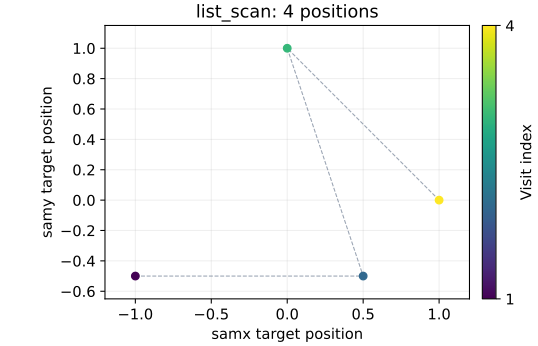
Use this when an evenly spaced trajectory does not describe the required positions.
log_scan
Move one or more motors together with logarithmically increasing spacing along their ranges.
- Inputs: one or more
(device, start, stop)bundles; required positivesteps: int. - Spacing: normalized fractions are
(logspace(0, 1, steps) - 1) / 9; each fraction is mapped ontostart + fraction * (stop - start). - Counts:
stepspositions. Motor coordinates can be zero or negative, or cross zero; it is the distance fraction that is logarithmically spaced.
scans.log_scan(dev.samx, -1, 1, steps=7, relative=False, exp_time=0.1)
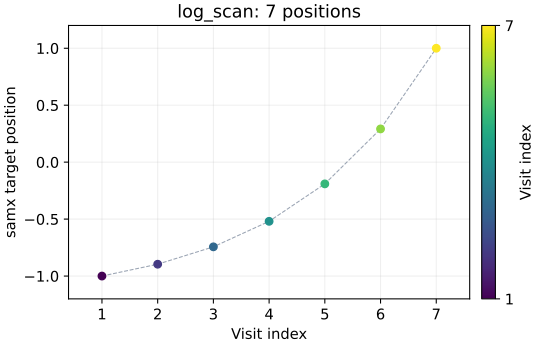
For constant spacing, use line_scan.
round_scan
Visit concentric rings, from the inner ring outwards, with more positions on each ring.
- Inputs:
motor_1,motor_2,inner_radius,outer_radius,number_of_rings,pos_in_first_ring, in that positional order. - Constraints: finite radii with
0 <= inner_radius < outer_radius; positive integer ring and first-ring counts. Both axes should use compatible distance units. - Options:
center_1=0,center_2=0define the center in the chosen coordinates. - Rings: ring
k, starting at 1, has radiusinner_radius + k * (outer_radius - inner_radius) / number_of_ringsandk * pos_in_first_ringpositions. The inner boundary is excluded and the outer included; no separate center point is added. A single ring lies atouter_radius.
scans.round_scan(
    dev.samx, dev.samy, 0, 1, 3, 6,
    relative=False, exp_time=0.1,
)
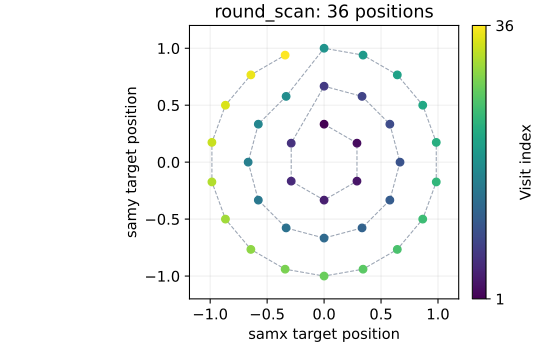
This example has 6 + 12 + 18 = 36 positions. For shells restricted to a rectangular
region, use round_roi_scan.
round_roi_scan
Generate circular shells and retain only positions inside a rectangular region of interest.
- Inputs:
motor_1,start_motor_1,stop_motor_1,motor_2,start_motor_2,stop_motor_2,shell_spacing,pos_in_first_ring. - Constraints: positive shell spacing and first-shell count; compatible axis distance units.
- Options:
center_1=0,center_2=0. The center may be outside the rectangle. - Counts: depend on how many shell positions fall inside the bounds. No separate center point is added; choose spacing and bounds that retain at least one position.
scans.round_roi_scan(
    dev.samx, -1, 1, dev.samy, -0.5, 0.5, 0.25, 6,
    relative=False, exp_time=0.1,
)
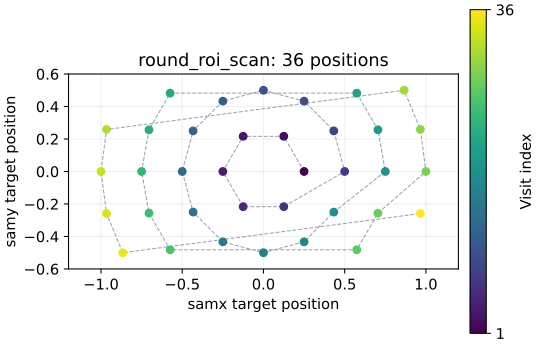
Unlike round_scan, the inputs describe rectangular bounds and shell spacing, not a ring count.
fermat_scan
Generate a Fermat spiral around the midpoint of a rectangle and retain positions inside it.
- Inputs:
motor1,start_motor1,stop_motor1,motor2,start_motor2,stop_motor2, and positivestep. Both axes should use compatible distance units. - Options:
spiral_type=0changes the angular increment; its accepted range is 0–2.optim_trajectory=Nonepreserves generation order."corridor","shell", or"nearest"reorder the generated positions to change the travel path. - Counts: depend on bounds and step. No separate center point is added; ensure the
generated trajectory is nonempty.
stepcontrols spatial density, not an axis point count.
scans.fermat_scan(
    dev.samx, -1, 1, dev.samy, -1, 1, 0.25,
    relative=False, exp_time=0.1,
)
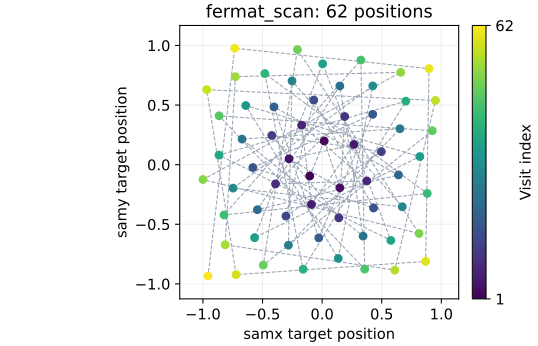
Trajectory optimization changes visit order, not the set of measurement positions.
hexagonal_scan
Visit staggered rows within rectangular bounds; alternate rows shift by half the first-axis step.
- Inputs:
motor1,start_motor1,stop_motor1,step_motor1,motor2,start_motor2,stop_motor2,step_motor2. - Constraints: positive step distances and nondecreasing bounds. These are distances,
unlike the integer axis counts supplied to
grid_scan. - Options:
snaked=True; the first motor traverses each row and the second selects rows. - Counts: number of positions retained inside the bounds. For a regular hexagonal lattice,
choose row spacing
step_motor2 = sqrt(3) / 2 * step_motor1.
scans.hexagonal_scan(
    dev.samx, -1, 1, 0.5, dev.samy, -1, 1, 0.4330127018922193,
    relative=False, exp_time=0.1,
)
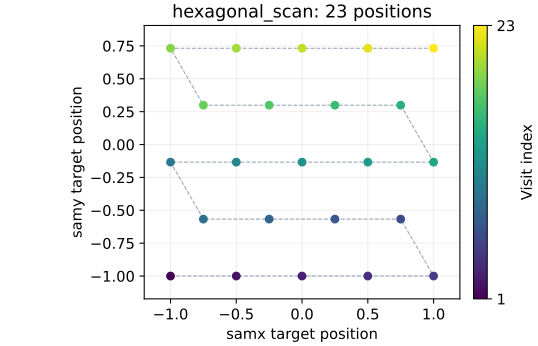
multi_region_line_scan
Visit a sequence of line regions on one motor, with an independent count for each region.
- Inputs:
motor; required keywordregions=[(start, stop, steps), ...]. Supply at least one region and positive counts. - Counts: concatenate inclusive region positions. If the end of one region is close
to the start of the next (
numpy.isclose), omit the next region's repeated first point. Regions otherwise retain their order, including gaps and reversed ranges.
scans.multi_region_line_scan(
    dev.samx, regions=[(-1.0, 0.0, 3), (0.0, 1.0, 5)],
    relative=False, exp_time=0.1,
)
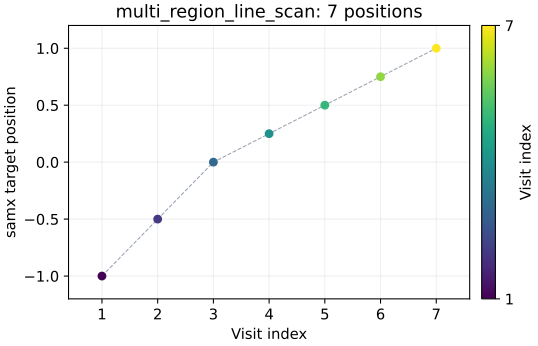
This example has seven positions, not eight. For multiple motors at explicit paired
positions, use list_scan.
multi_region_grid_scan
Visit a sequence of rectangular grids on two motors.
- Inputs:
motor1,motor2; required keywordregions=[((start1, stop1, steps1), (start2, stop2, steps2)), ...]. Supply at least one paired region and positive axis counts. - Options:
snaked=True; the first motor changes fastest within each grid. - Counts: sum of each grid's axis-count product. Regions are concatenated in order; overlapping positions are retained, and snaking starts afresh in each region.
scans.multi_region_grid_scan(
    dev.samx, dev.samy,
    regions=[((-1.0, 0.0, 3), (-1.0, 0.0, 3)),
             ((0.5, 1.0, 3), (0.5, 1.0, 2))],
    relative=False, exp_time=0.1,
)
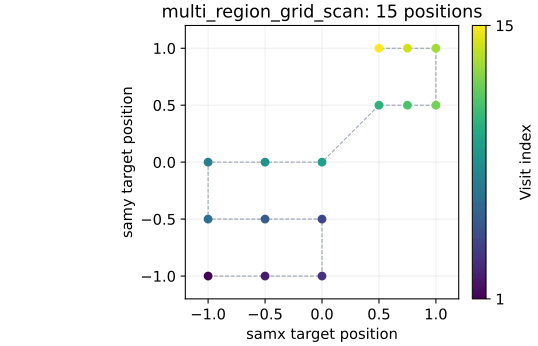
This example has 9 + 6 = 15 positions.
Moving acquisition
Both built-ins below use software triggering while the motor moves. Neither accepts
burst_at_each_point. Their recorded samples depend on motor readback updates and
acquisition timing, so they have different constraints from a stationary step scan.
cont_line_scan
Move continuously and acquire when the readback is close to successive predefined targets.
- Inputs:
device,start,stop,steps; required keywordrelative. - Options:
offset=None,atol=None,exp_time=0,readout_time=0,frames_per_trigger=1. - Counts:
stepsexpected monitored readouts. Use at least two targets: preparation computes spacing from the first two. Use increasing targets and a positive motor velocity. - Device requirements: readable
velocity,acceleration, and readback precision. Motor settings are used as configured; the scan does not set a requested speed. - Motion: starts at
start - offsetin the resolved coordinates, then moves tostop. The approach position is included in the limit check. Withoffset=None, the approach distance is calculated from acceleration and velocity. - Sampling:
atolis the absolute position-matching tolerance; its automatic value depends on velocity, exposure and precision. Skipping a target, finishing before all targets are acquired, or insufficient time per step causes an abortion.
scans.cont_line_scan(
    dev.samx, -1, 1, 5, relative=False, exp_time=0.1,
)
Use line_scan to stop at each target. Use line_sweep_scan
for readback-driven acquisition without a predefined target grid. Continuous-line samples
match a tolerance window rather than an exact stationary position.
line_sweep_scan
Acquire in response to readback updates while one motor moves from start to stop.
- Inputs:
device,start,stop; required keywordrelative. - Options:
exp_time=0,frames_per_trigger=1,min_update=0,max_update=0. - Timing:
min_updateadds a delay after each acquisition. Positivemax_updateallows acquisition when no readback update has arrived within that time;0disables this fallback. Both values are nonnegative seconds, not exact sampling periods. - Counts: determined during motion. There is no
stepsargument or predefined point count; the initial count is zero. Actual samples depend on update rate, motion duration and the trigger/read cycle. Short moves may yield few or no samples.
scans.line_sweep_scan(
    dev.samx, -1, 1, relative=False, exp_time=0.1, min_update=0.1,
)
The scan first moves to start, then acquires during the move to stop. For acquisition
near a fixed number of targets, use cont_line_scan.
Other requests
mv and umv are move requests, not acquisition scans. They do not produce the ordinary
scan-point series and master-file result described above. device_rpc is an internal
request used for device communication, not an acquisition entry in the client catalog.
See Move a device and
Important BEC commands for related commands.